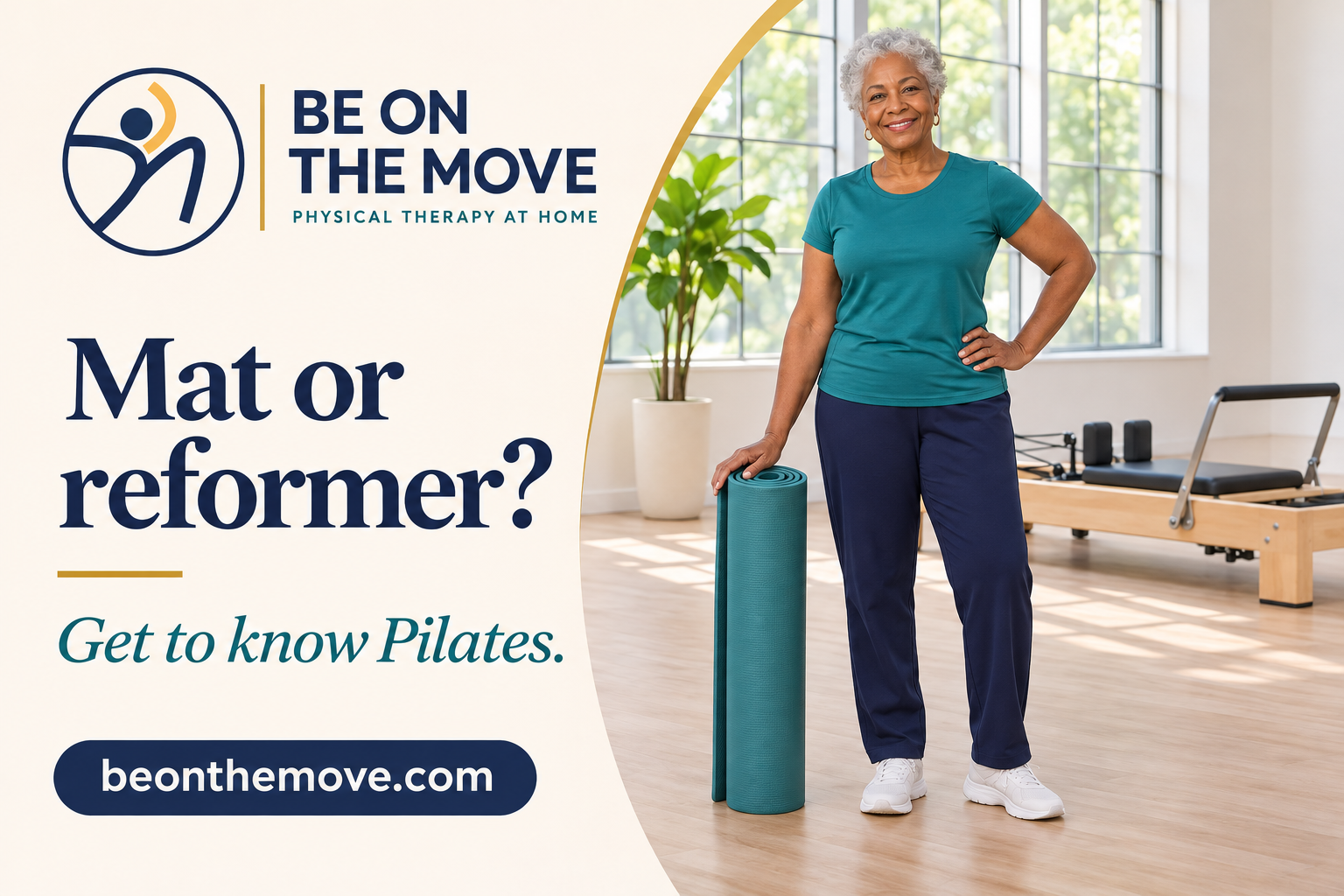
Mat or Reformer? Understanding Pilates Before Your First Session
One Pilates photo shows a person on a mat. Another shows a padded platform, a footbar, straps and springs. Both carry the same exercise name, yet they can look like entirely different activities. If you are curious about trying Pilates, that difference is worth understanding before you buy equipment or book a package of classes.
For older adults in Palm Beach County, the interesting question is not whether you can match a pose from a video. It is what the setup asks you to do. Where does the resistance come from? What supports your body? How do you get into position? Who explains the equipment? Those details say more about the experience than a photograph of someone looking effortless.
Pilates remains a subject of current health coverage. Harvard Health's February 2026 introduction specifically discusses options for people as they get older, including mat, reformer and chair adaptations. That is useful context, not proof that one format is best for everyone. Read Harvard's publicly available introduction.
Start with the surface underneath you
In mat Pilates, the floor provides a fixed surface. Your own body supplies much of the challenge as you control movement against gravity. A reformer adds a moving carriage connected to springs, with other components such as a footbar and straps. These are different ways of arranging movement, not a beginner-to-advanced ranking.
Cleveland Clinic describes Pilates as controlled movement with attention to the trunk and breathing. Its introduction also warns against assuming that mat work is easier than reformer work. The presence of machinery does not automatically make a session more demanding, and the absence of machinery does not make every floor exercise gentle. Cleveland Clinic explains the basic formats.
Think about the practical difference before thinking about the price. A floor-based session includes getting down to the mat and back up again. A reformer session includes approaching and getting onto equipment that has moving parts. Neither transition should be an unexpected test at the start of a class. Ask the studio to describe it before you arrive.
A photograph often leaves this part out. It captures the middle of an exercise, after the person has already found the position and received instructions. You are entitled to ask about the beginning and the end of the movement, too. There is no need to demonstrate a difficult transfer at home just to decide whether to telephone a studio.
The surprising part about springs
A reformer's springs change the resistance of its carriage. But more spring does not always mean a harder exercise. Depending on the movement, spring tension can also provide support; a lighter setting may demand more control. The relationship is more complicated than adding another plate to a weight stack.
Pilates Anytime's February 2026 equipment guidance explains this distinction and notes that spring systems differ among manufacturers. A color mentioned in one video should not be treated as a universal setting for every machine. Read its spring explanation.
For a newcomer, the useful skill is learning what the instructor means on the equipment in front of you. Before a session begins, ask who sets the springs, how changes are explained and what to do if you miss a cue. Leave unfamiliar adjustments to the instructor. Do not remove resistance because a lighter setting sounds more appropriate for a beginner.
This is also a reason to be cautious about buying a machine first and looking for instruction afterward. A video may use equipment with a different spring system, carriage height or arrangement of straps. Being able to fit a reformer into a room does not mean the video and the machine are a suitable match.
Read beyond the words “low impact”
Low impact is a description of how an activity is performed, not a medical clearance. A session can avoid jumping and still involve demanding positions, sustained effort or movements that need modification. The label does not tell you whether a particular exercise suits a healing injury, a painful joint or a history of spine fractures.
This matters especially with osteoporosis. The Bone Health & Osteoporosis Foundation notes that Pilates movements involving spinal bending and twisting may need to be avoided or modified. Someone with osteoporosis or a previous spine fracture should get specific guidance rather than copying a roll-up, deep bend or twisting sequence from a general class. Read the foundation's safe-movement guidance.
The answer is not necessarily to rule out Pilates. It is to identify the movements involved and whether an appropriate version is available. A description such as “all levels” leaves this unanswered. Ask for a concrete description of positions and transitions rather than relying on reassuring adjectives.
A fitness instructor and a treating clinician have different roles. If you are receiving rehabilitation or have activity restrictions, take those instructions into the discussion. A class advertised as gentle does not replace an assessment, and a studio's use of the word clinical does not by itself establish what healthcare service is being provided.
Balance research is encouraging, but the outcome matters
A 2019 randomized study in Spain included 110 women aged 60 and older. A 12-week Pilates program was compared with a group receiving no intervention. The researchers reported benefits in balance confidence, fear of falling and some measures of postural control. Those are useful findings about the outcomes studied. They are not the same as demonstrating that a particular studio class will prevent an individual's next fall. Read the original study record.
A separate 2021 systematic review also found improvements in some measures related to falling, while emphasizing the absence of high-quality evidence about reducing actual falls. That distinction can disappear in a headline. A better score on a balance assessment, feeling less afraid of falling and experiencing fewer falls are related questions, but they are not interchangeable results. Read the review and its limitations.
Neither finding establishes that reformer Pilates is universally superior to mat Pilates. Nor does it justify a promise that buying equipment will prevent fractures. When a class description offers a large benefit, look for the population studied, the comparison group and the outcome actually measured. A testimonial cannot supply those missing details.
What an introduction should make clear
Before committing to a series, look for an introduction that explains the method as well as the movements. You should know whether the session is mostly on a mat, on a reformer, seated or a mixture. Ask whether the advertised beginner session includes equipment orientation, rather than assuming it does.
- Positions: Does the session involve kneeling, lying down, standing or supporting weight through the hands?
- Transitions: How are getting onto the equipment and getting off it taught?
- Instruction: Can the teacher see your setup and explain an alternative when needed?
- Format: Is the class live, a recording, or an independent workout following a screen?
- Commitment: Can you understand the format before paying for a longer package?
These questions are useful whether the studio is nearby or you are considering an online option. A recording can be paused, but it cannot notice that you misunderstood a strap instruction. A live group has an instructor, but you still need to know how questions are handled and whether the pace leaves room to learn.
You also do not need to buy every accessory shown in an advertisement. Find out what the actual session requires and what the venue supplies. A ball, ring or band may belong to one lesson rather than being a prerequisite for Pilates as a whole. The first purchase should not be a substitute for understanding the class.
Give Pilates a place, rather than every job
Pilates can be one part of an active week. It should not automatically be counted as covering every exercise need simply because it feels challenging. CDC guidance for older adults includes aerobic activity, muscle-strengthening activity and balance work, adjusted to abilities and health conditions. What a particular Pilates session contributes depends on what you actually do in it. See the CDC overview.
For example, a session spent learning equipment and breathing cues is a different experience from a sustained aerobic outing. You can value the learning without pretending the two are identical. Keeping room for other appropriate activities also avoids making one class responsible for every part of your fitness.
Be On The Move provides physical therapy at home in Palm Beach County. If pain, balance concerns or difficulty changing positions is limiting your activity, a physical therapy assessment can help clarify those limitations. That is separate from choosing a Pilates membership; this article does not imply that BOTM operates a Pilates studio.
Keep these distinctions in mind
- A mat and a reformer arrange support and resistance differently; neither is automatically the easy option.
- Spring tension is part of the movement setup, not a simple score of how hard you are working.
- Low impact does not mean every movement is suitable for every health condition.
- Improvements in balance measures do not justify a guaranteed fall-prevention claim.
- Learn the format and the equipment before committing to a routine or a purchase.
Curiosity is enough to start the conversation. You do not need to arrive already knowing the terminology. A useful first session should leave the mat, the carriage and the instructions less mysterious than they were when you walked in.
See you soon,
//❤️ Trudy//
The information provided in this article is intended for general educational and informational purposes only. It is not a substitute for professional medical advice, diagnosis, or treatment. Always seek the advice of your physician or other qualified health provider with any questions you may have regarding a medical condition or before starting any new exercise program. If you experience any pain or difficulty with exercises or advice mentioned in this article, stop immediately and consult your healthcare provider. Be On The Move and its representatives do not assume any responsibility for any aspect of healthcare administered with the aid of information provided herein.