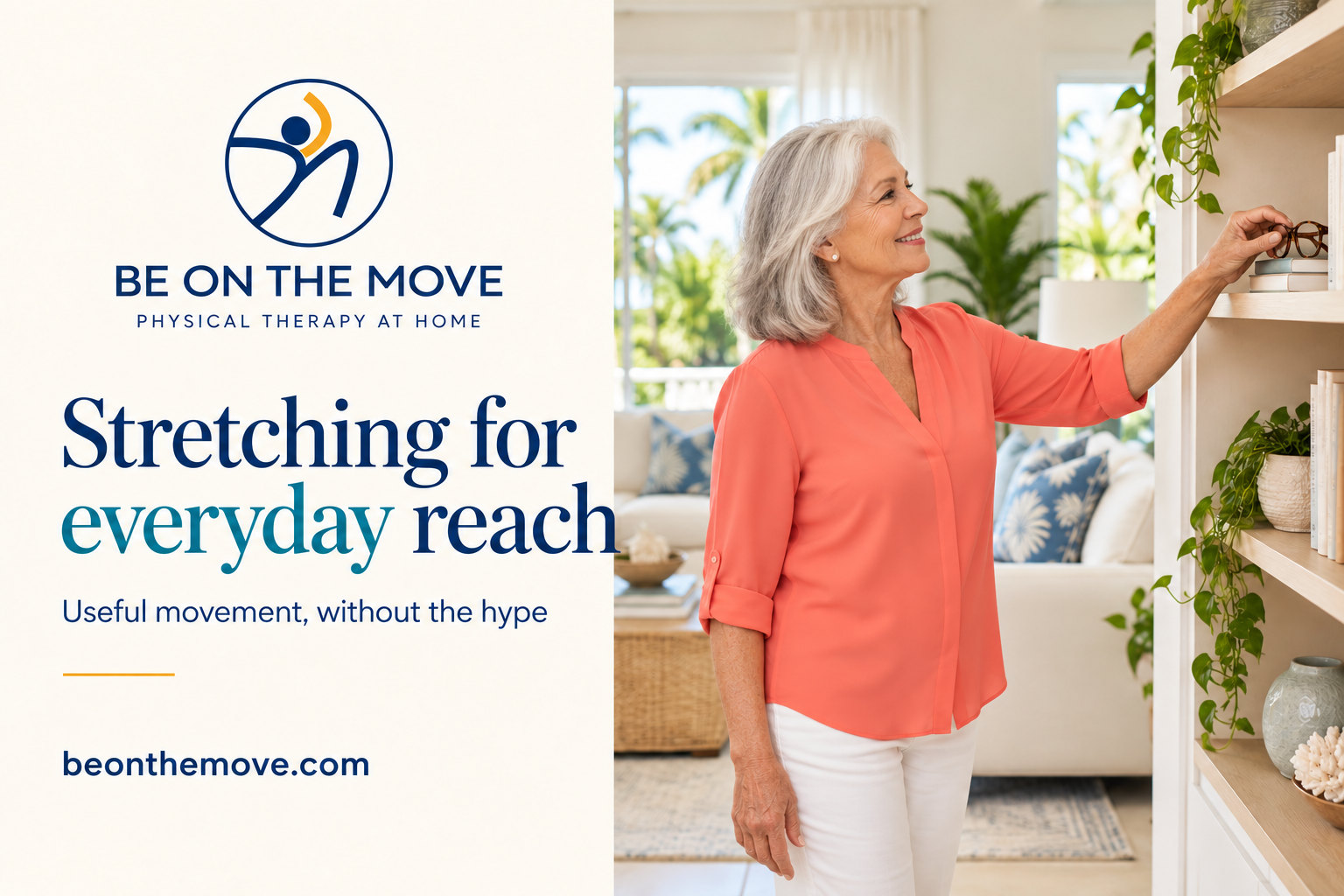
Stretching for Everyday Reach: Useful Movement, Without the Hype
Reaching into a sleeve, turning toward a conversation and placing a book on a shelf rarely look impressive on camera. They are ordinary movements, and that is exactly why they matter. Flexibility becomes useful when it gives you room to move through your day—not only when it produces a dramatic photograph.
Online, stretching can seem to come with two competing messages. One says everyone should become much more flexible. Another treats a simple flexibility test as a forecast of future health. Neither message tells an older adult very much about a stiff shoulder, a comfortable reach or what belongs in an exercise routine.
A better way to read the conversation is to separate three questions: How far can a joint move? How well can you control that movement? And what has research actually shown about the benefit of changing it? Those questions leave room for stretching without asking it to do every job in fitness.
What does “more flexible” actually describe?
Range of motion describes the movement available at a joint. Flexibility is commonly discussed in relation to that range and the tissues around it. In everyday life, however, having room to move and being able to use it are not quite the same thing. Bringing an arm into position, holding an object and returning it to a shelf also involve muscular effort and control.
Think of reaching for a light book as an illustration, not a self-test. Moving the arm toward the shelf is one part. Managing the book’s weight is another. Standing comfortably while doing it adds yet another demand. A stretch may address a particular limitation in movement; it does not automatically train everything happening in that example.
This is why a single photograph cannot describe someone’s overall mobility. A deep forward bend tells you little about their ability to carry an object or respond to a loss of balance. Likewise, an ordinary-looking movement can require considerable coordination. There is no need to make a stretch look more impressive to make the question behind it worthwhile.
The useful question behind the current stretching conversation
Harvard Health’s March 2026 guidance includes regular flexibility work within a broader routine. An April 2026 AARP headline also brings flexibility and longevity into the discussion. These are reasons to examine the subject carefully, not proof that one routine has become a national standard.
Independent discussions in a flexibility community and an aging community show people asking whether they can improve and how much range is useful. The replies mix personal experiences with advice of uneven quality. They reveal genuine questions, but cannot establish treatment effects or how common a concern is among American seniors.
The practical question is therefore narrower than “Should I be flexible?” It is whether the kind of movement being practiced matches the issue being discussed. A general stretching video, a clinical examination and a strength exercise can all involve the same body region while serving different purposes.
A new study separates range from strength
A randomized trial published September 28, 2026 studied 68 community-dwelling older adults with hamstring tightness and possible sarcopenia, or loss of muscle strength and mass. Participants were assigned to higher-volume stretching, lower-volume stretching, eccentric exercise or a non-exercise control for six weeks.
Both stretching groups increased range of motion, with no statistically detectable difference between their gains. That does not establish that the two schedules were equivalent. Eccentric exercise, in which muscles work while lengthening, produced a different pattern of strength improvement. The study did not find consistent intervention-related improvements in balance or physical function.
The published abstract supports a modest conclusion: flexibility and strength outcomes can differ. It does not justify turning the trial’s schedules into a universal home prescription, promising fewer falls or assuming that additional range necessarily changes daily function. The sample was small and selected for specific difficulties; the results should not be applied to every older adult or every joint.
Why a flexibility score cannot tell your future
The longevity discussion draws partly on a 2024 observational study of 3,139 adults aged 46–65. Researchers combined 20 movements across seven joints into a flexibility score and followed mortality over an average of about 13 years. Greater flexibility was associated with lower mortality.
People were not randomly assigned to become more flexible, however. The study cannot show that stretching caused anyone to live longer. Its authors called for research to determine whether training-related flexibility gains affect survival. A home toe-touch is also not the same assessment as that research protocol.
If you cannot reach a particular position, do not turn that result into a prediction about your lifespan. It can be a movement question worth discussing. It is not a personal countdown, and it is not a reason to force a painful stretch.
Give a stretch the right place in the session
Static stretching means holding a position; dynamic movement involves moving through a range. Those labels describe what you do, rather than guaranteeing a particular result. A slow held position and a gentle walking warm-up are not interchangeable just because both happen before a workout.
Mayo Clinic advises warming up with light activity before stretching, using smooth movements without bouncing and avoiding pain. Its general guidance describes a hold of about 30 seconds, but that is not a requirement to endure an uncomfortable position. Existing injuries and chronic conditions can change what is appropriate.
For someone who has already been given a stretching exercise, the details of the instruction matter. Which position was demonstrated? Was support part of it? Was the instruction to move, to hold or to relax? Replacing those details with a deeper version found online changes the activity. Clarify an unclear instruction rather than assuming that more intensity is the intended next step.
Read a stretching video before copying it
The setting in a short video often disappears from attention. Look at what the person is using: a floor mat, a wall, a chair, a partner or a strap. Then look at the transitions. Getting into a position and getting out again are part of the activity, even when an edited clip shows only the middle.
Also notice what the video claims to measure. “Can you reach this far?” is different from “Can you use this movement comfortably?” Neither question, on its own, shows that an exercise prevents disease. Be especially cautious with a headline that converts one movement into a biological age or a guaranteed number of extra years.
These are ways to evaluate the information, not instructions to perform a series of tests. You do not need to reproduce an extreme demonstration to decide whether the explanation is clear. A useful educational resource should make its purpose understandable without pressuring the viewer to compete with the person on screen.
Keep room for the other parts of movement
CDC guidance for older adults includes aerobic activity, muscle strengthening and balance activity. It recommends at least two days of strengthening each week, alongside aerobic activity and work on balance, with activity adjusted to ability and health conditions. Stretching does not automatically replace those different demands.
That distinction can simplify a crowded exercise menu. A routine does not become complete because it contains many stretches, and an exercise does not become a stretch because a muscle feels lengthened during it. Ask what the movement is intended to practice. Clear language makes it easier to understand why two exercises that look similar might both appear in a program.
There is also no obligation to organize the entire day around flexibility. A shelf can hold a frequently used item at an easier height. A jacket can be arranged where it is convenient to put on. Making an activity more manageable today and exploring a movement limitation are compatible choices; ordinary life does not need to become a constant examination.
When everyday reach deserves a closer look
If a particular reach or turn is becoming difficult, describe the actual movement rather than simply saying you are “not flexible.” Whether the difficulty happens while lifting the arm, holding an object or returning to the starting position gives a clinician a clearer account of the problem. That description is more useful than comparing yourself with a photograph.
Be On The Move provides physical therapy at home in Palm Beach County. An assessment can consider the movement itself and the surroundings in which it happens. It should not begin with the assumption that every limitation needs a stronger stretch, or that a flexibility score explains the whole person.
For help understanding a movement that has become difficult, contact Be On The Move about in-home physical therapy. The purpose is to understand what is limiting that activity and which approach is appropriate—not to chase the deepest possible position.
Key takeaways
- Everyday movement involves available range, strength and control; one flexibility demonstration cannot assess all three.
- A recent older-adult trial found different patterns of flexibility and strength adaptation, without consistent improvements in balance or physical function.
- An association between flexibility and longevity does not prove that stretching extends life.
- Warm up before stretching, avoid bouncing or pain, and follow instructions appropriate to your circumstances.
- Keep stretching in perspective alongside aerobic, strengthening and balance activity.
See you soon,
//❤️ Trudy//
The information provided in this article is intended for general educational and informational purposes only. It is not a substitute for professional medical advice, diagnosis, or treatment. Always seek the advice of your physician or other qualified health provider with any questions you may have regarding a medical condition or before starting any new exercise program. If you experience any pain or difficulty with exercises or advice mentioned in this article, stop immediately and consult your healthcare provider. Be On The Move and its representatives do not assume any responsibility for any aspect of healthcare administered with the aid of information provided herein.