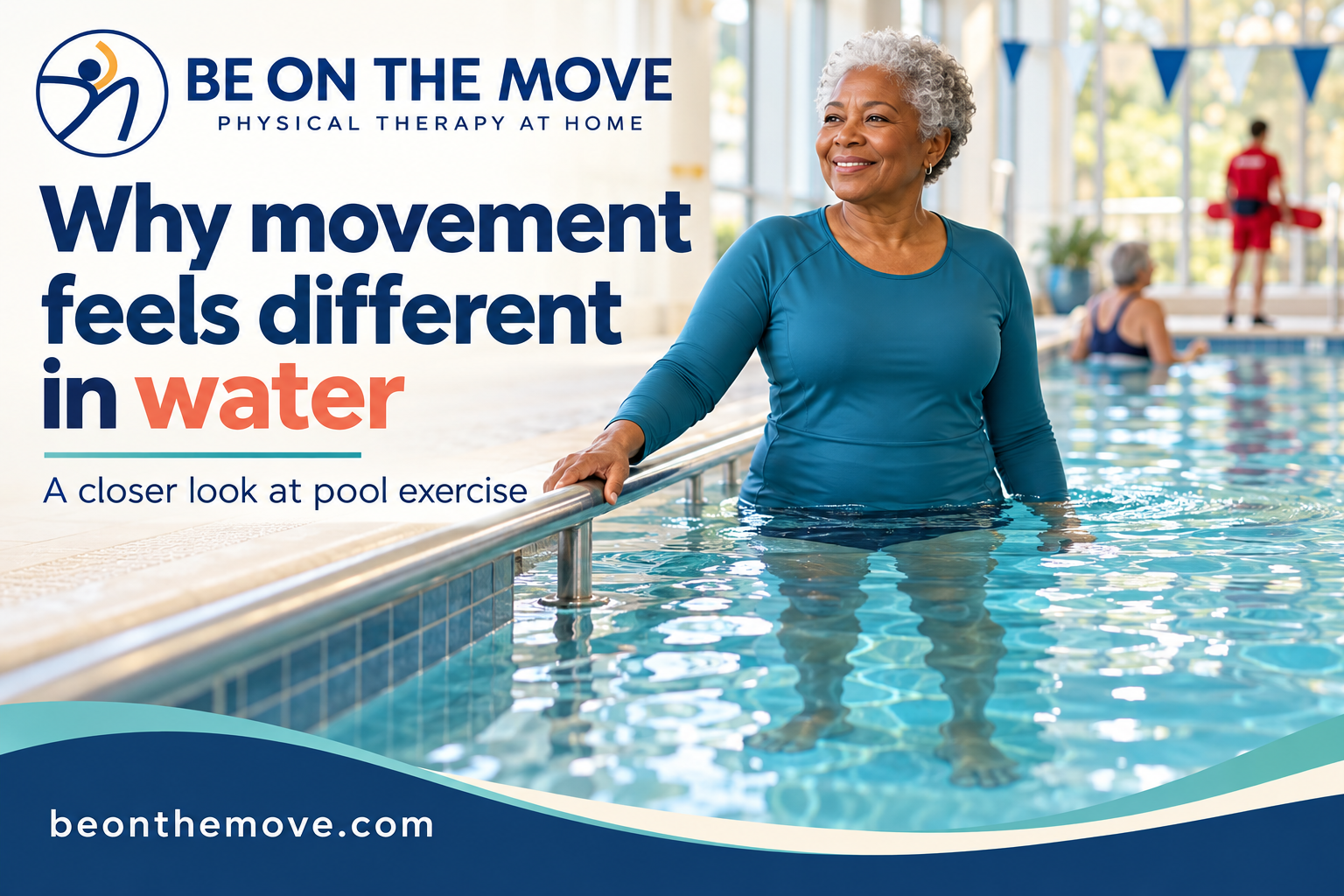
Why Movement Feels Different in Water
A pool changes the rules of movement. Your body feels lighter, yet pushing an arm through the water takes effort. A familiar step becomes slower. Standing upright and moving a few feet can feel quite different from crossing the same distance on a sidewalk.
That combination—support and resistance—is what makes water exercise interesting. It is more than a gentler version of swimming laps, and it is not simply a place to rest sore joints. Understanding what the water changes helps explain both its appeal and its limits.
For older adults who are curious about pool exercise, the most useful starting point is not a promise that water is better than land. It is a closer look at how the environment works, what different programs offer and which details matter before getting in.
Water exercise continues to receive attention in Harvard Health’s March 2026 exercise coverage and Oak Street Health’s senior-focused guide, updated October 16. Independent online discussions also raise questions about enjoyment, access and returning to the pool. That is evidence of an active conversation, not a measured nationwide trend or proof that a program will work for you.
Two things happen at once: the water supports you and pushes back
Buoyancy is the upward force that water exerts on an immersed body. It reduces the amount of body weight your feet and legs must support while standing in a pool. The effect changes with how much of your body is submerged. This is one reason a movement that feels demanding on land may feel more manageable in water.
But lighter does not mean effortless. Moving through water creates resistance. Your arms and legs have to displace the water around them. The direction and speed of movement, and the amount of surface moving through the water, change that resistance.
These two effects can coexist. Water can reduce loading through a painful joint while still making muscles work. That is different from assuming the pool removes every physical demand. A lively water workout can be tiring even without the repeated impact of landing on a hard surface.
The Arthritis Foundation describes water exercise as an option that can allow movement with less joint stress. It also emphasizes that access, confidence around water and the kind of instruction available affect whether the option is practical.
You do not need to calculate a percentage of body weight or choose a particular water depth on your own. Those details depend on the activity, the pool and your abilities. An instructor or aquatic therapist should explain the setup rather than leaving you to discover it by trial and error.
“Pool exercise” does not describe just one activity
The words swimming, water fitness and aquatic therapy are sometimes used as though they mean the same thing. They do not. A lane-swimming session, an upright group class and a rehabilitation appointment can all take place in water while asking very different things of a participant.
| Format | What to clarify |
|---|---|
| Swimming laps | Required swimming skill, stroke demands and lane arrangements. |
| Upright water exercise | Water depth, whether feet stay on the floor, pace and supervision. |
| Aquatic physical therapy | Clinical assessment, treatment goals and the therapist’s role in your care. |
Cleveland Clinic notes that water exercise can include walking in a pool as well as organized classes. You do not have to assume every pool activity requires continuous lap swimming. At the same time, a class described as suitable for beginners does not automatically make it appropriate for someone who is uncomfortable or unsafe in water.
Ask what participants actually do. Will you remain upright? Will your feet stay on the bottom? Is there a rail nearby? Does the program include floating or deep water? Explain your swimming ability honestly before joining. Flotation equipment used for exercise is not a substitute for appropriate water-safety supervision.
The evidence supports an option—not a miracle treatment
Research on aquatic exercise is especially relevant to people with knee or hip osteoarthritis. In a Cochrane review of 13 trials involving 1,190 participants, programs produced small short-term improvements in pain and disability compared with control groups that did not receive aquatic exercise. Participants’ average age was 68. On a 100-point scale, the average difference in pain was about five points after the program.
That is a useful result, but it is not a promise of pain-free movement. The review evaluated structured programs, and its findings mainly describe the period immediately after treatment. It did not establish that casual pool time repairs joint damage or provides lasting relief for everyone.
Comparisons with land exercise also vary. A randomized trial of 60 people with knee osteoarthritis found greater improvement with an eight-week aquatic program than with the land program it tested. An earlier trial involving 79 participants did not find the same advantage: only its land-exercise group showed some improvement in pain at follow-up compared with the control group.
The practical reading is modest. Water exercise is a reasonable option to discuss, particularly when the environment makes movement more tolerable. The evidence does not identify a single winner for every person, every joint condition or every program. A study comparing two specific routines cannot tell you that any pool class is better than any exercise on land.
Why “low impact” can still mean a workout
Impact and effort describe different things. Impact concerns forces such as those created when a foot lands. Effort concerns how hard you are working. A movement can involve relatively little impact and still require considerable muscular or cardiovascular effort.
This distinction matters when a session feels comfortable at first. The water’s support may make it tempting to keep going longer or move faster. Yet adding speed or equipment changes the task. Foam hand weights, paddles and other pool tools are not automatically easy simply because they look light on the deck.
Let the instructor explain the purpose of equipment and how to use it. Begin with the version appropriate for you, rather than copying the most energetic participant. If an exercise causes pain, dizziness or unusual breathlessness, stop and get help. Comfortable movement is not a reason to ignore symptoms or restrictions you have been given.
A pool can also make familiar movements feel unfamiliar. Turning, stopping and changing direction happen against moving water. Give yourself time to understand the setting instead of expecting your usual walking pace or workout rhythm to transfer exactly.
The route into the pool is part of the activity
A program can sound ideal on paper and still be difficult to access. Before focusing on the exercises, look at the entrance and exit. Broad steps with usable rails, a ramp or a lift offer different options from a vertical ladder. Confirm what is available and whether staff can assist with the equipment you need.
Think about leaving the pool as carefully as entering it. You may be tired by the end of a session, and the water’s support decreases as you come out. An exit that felt manageable beforehand still needs to work afterward. Tell the instructor if stairs, gripping a rail or standing on a wet deck are difficult.
Check the surface between the pool and your changing area, where you can sit to get ready, and how you will carry your belongings. These are concrete features of the setting, not reasons to rule out water exercise. Knowing them in advance helps you assess whether a particular facility is usable.
The CDC recommends checking pool inspection information, lifeguard presence and safety equipment. Clear-looking water alone does not establish that a pool is well maintained. Follow the facility’s rules, use appropriate supervision and do not exercise in the water alone.
Recent surgery changes the conversation
Someone else’s recovery timeline is not permission to enter a pool after your own procedure. An incision, an infection concern or a surgical restriction can change what is appropriate even if you feel ready to move. Ask your surgical team when immersion and water exercise are allowed, and whether specific movements are restricted.
CDC guidance advises staying out of the water with an open cut or wound, particularly one from surgery. If you have a weakened immune system, discuss water activities with your healthcare provider. People with pre-existing health conditions should also clarify whether the planned activity and pool environment are suitable.
This is where general water fitness and rehabilitation differ. A group instructor may offer exercise variations, but that is not the same as assessing a healing joint or managing a medical condition. If you need aquatic physical therapy, ask about a qualified service rather than assuming a recreation class provides it.
Keep the connection to life on land
Most daily activities still happen outside the pool. Getting out of a chair, carrying a bag and walking across a room involve supporting your body without the same buoyancy. The fact that a movement feels easier in water does not automatically show that the same task has become easier on land.
That does not diminish the value of the pool. It simply keeps expectations specific. Water exercise may provide an appealing setting for activity, while land-based practice addresses different demands. Depending on your needs, the two can be parts of the same broader routine rather than competing choices.
If getting to a pool is inconvenient or you do not enjoy water, you have not missed the only useful way to exercise. Access, preferences and the activity you can sustain all matter. Pool exercise is an option, not an obligation or a test of commitment.
Key takeaways
- Buoyancy reduces loading, while water resistance still makes movement work.
- Lap swimming, upright water fitness and aquatic physical therapy are different activities.
- Research supports modest short-term benefits for some people with knee or hip osteoarthritis, not a universal advantage over land exercise.
- Check entry, exit, supervision and medical restrictions before joining a program.
- Keep everyday movement on land in view when considering what a pool program can offer.
Be On The Move provides physical therapy at home in Palm Beach County. If changes in mobility are limiting everyday activities, contact Be On The Move to discuss an assessment. This article is general education about water exercise; it does not announce a BOTM pool program or aquatic therapy service.
See you soon,
//❤️ Trudy//
The information provided in this article is intended for general educational and informational purposes only. It is not a substitute for professional medical advice, diagnosis, or treatment. Always seek the advice of your physician or other qualified health provider with any questions you may have regarding a medical condition or before starting any new exercise program. If you experience any pain or difficulty with exercises or advice mentioned in this article, stop immediately and consult your healthcare provider. Be On The Move and its representatives do not assume any responsibility for any aspect of healthcare administered with the aid of information provided herein.