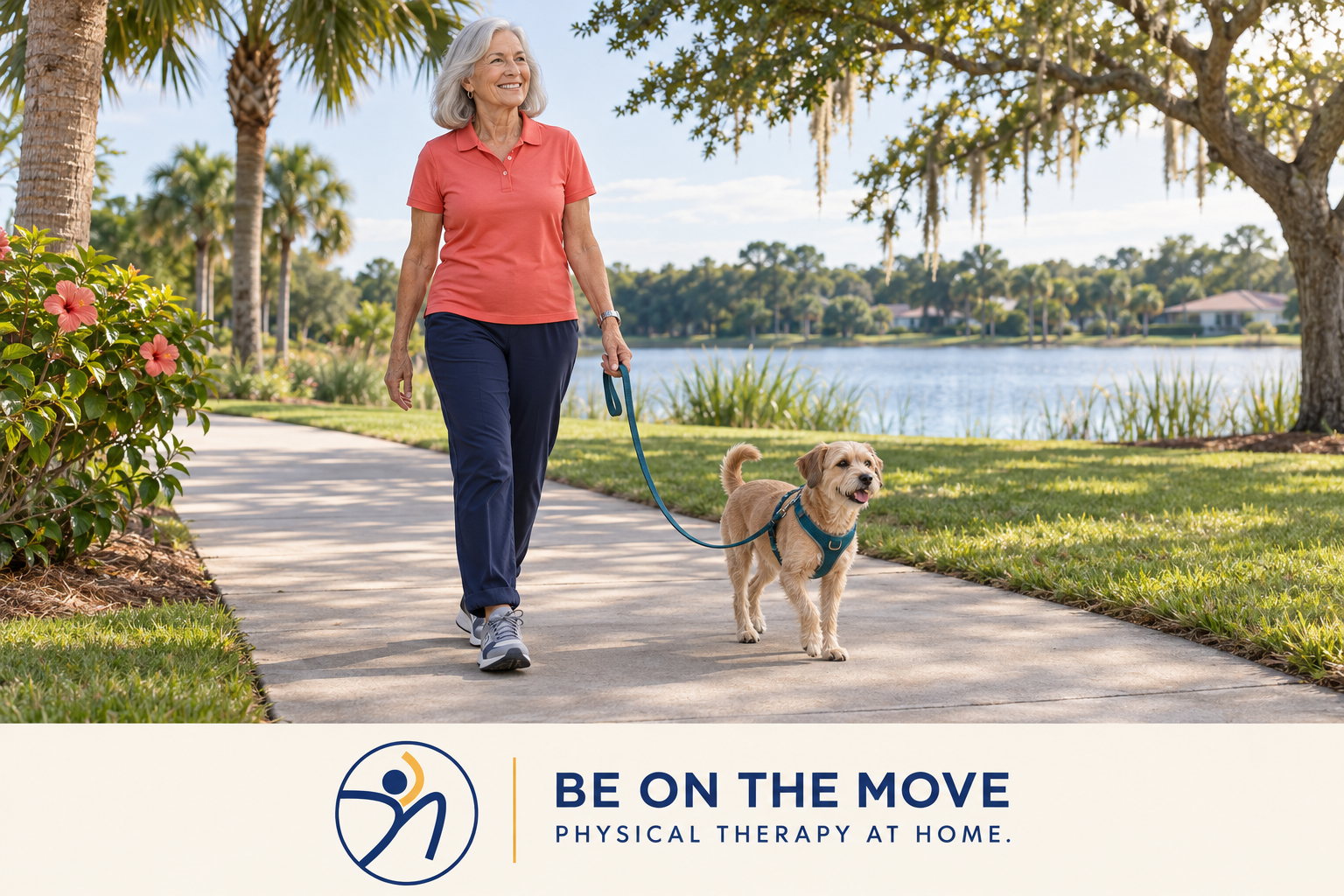
Dog Walking Without the Tug-of-War
The leash comes out, the dog is ready, and an ordinary walk suddenly has two agendas. You may want a comfortable loop around the neighborhood. Your companion may want to investigate every hedge, greet another dog, or change direction without warning.
For an older adult, that difference matters. Dog walking involves more than covering a distance: it also means managing an unpredictable pull through one hand while staying upright. Enjoying the company of a dog and being the right person to hold its leash are related decisions, but they are not the same decision.
This is not an argument for giving up a valued routine. It is a closer look at the part of the walk that deserves its own plan. A calmer outing may depend less on buying another accessory and more on changing who handles the leash, how the dog behaves, and what happens before you leave the door.
What the injury research actually measures
A U.S. study published in 2023 examined emergency-department injuries associated with walking a leashed dog. Falls after being pulled or tripped by the leash were common mechanisms. Within the injured population, older adults had greater odds of certain serious injuries than younger adults. Read the original study record.
Those findings do not tell us the chance that any particular walk will end in an injury. The researchers studied people receiving emergency care, not every person who walked a dog and returned home uneventfully. Nor do the results prove that dog walking is more dangerous than every other form of activity. The useful lesson is narrower: the leash and an unexpected change in direction deserve attention, especially when a fall could have serious consequences.
A systematic review appearing in the January 2026 issue of Injury Prevention also describes hand and wrist injuries associated with dog walking. Pulling was an important mechanism in the included studies. It is a review of existing injury research, not a trial showing that one leash or harness prevents falls. See the review abstract.
Start with the pull, not the dog's reputation
A friendly dog can still lunge toward a squirrel. A familiar dog can react differently when another animal appears. Describing a pet as gentle, loving, or usually well behaved does not answer the practical question: can the person holding the leash manage its actual behavior on this outing?
Notice the situations that change the walk. Is the difficult moment leaving the house, passing another dog, approaching a busy entrance, or returning through a gate? These are useful details for a qualified dog trainer or veterinarian. They are more informative than assuming that every walk is equally manageable because most of it goes smoothly.
Do not turn that observation into a test of your strength. If pulling has already caused a stumble or fall, arrange another capable handler while you address the problem. Repeating the same setup to see whether you can hold on harder adds no useful reassurance. The dog's affection for you does not make a sudden pull predictable.
Your hand should not become the anchor
Wrapping extra leash around your fingers or hand can feel secure. It also creates a way for a sudden pull to twist or trap them. Hand specialists at Rush advise against wrapping the leash and caution against hooking fingers beneath a dog's collar. These are ordinary handling moments, not just problems during a long walk. Read Rush's leash-handling guidance.
The American Society for Surgery of the Hand's August 2026 advice likewise highlights finger protection while walking a dog. The practical warning about wrapping is worth reviewing before the next outing. Ask for a demonstration of handling that suits both you and the equipment rather than copying a complicated grip from a still photograph. Read its hand-therapy advice.
A retrospective outpatient study of dog-leash hand and wrist injuries reinforces why these injuries deserve attention. However, its patients came to a specialist practice; it cannot tell every dog owner their personal risk or establish a proven prevention technique. Even protecting the fingers does not remove the possibility of being pulled off balance. Read the study and its limitations.
A shopping label cannot settle the safety question
Equipment described as “no pull,” “hands free,” or “easy control” can sound like a complete solution. A label does not establish that the device is suitable for your balance, grip, walking aid, or dog's behavior. Taking the leash out of your hand does not make the force of a lunge disappear.
A 2024 review identified important gaps in the injury literature, including details about the dogs, training status, and leash types involved. That limits confident claims about which product is safest for which person. Read the review's discussion of missing information.
Bring equipment questions to a qualified trainer or veterinarian, and bring concerns about your own movement to your clinician or physical therapist. These professionals address different parts of the problem. Dog training is not physical therapy, and improving your balance does not train a dog to stop pulling.
If you use a cane or walker, do not improvise an attachment to it or change a prescribed walking-aid technique simply to accommodate the leash. Ask how the two tasks can be managed together, or whether someone else should handle the dog. A device you rely on for support needs to remain available for its intended purpose.
Sharing the walk can keep the companionship
There is a middle option between walking the dog alone and losing the outing entirely: another capable person can handle the dog while you join them. Your part of the walk can then be chosen for your walking ability, rather than for the dog's exercise needs or enthusiasm.
That arrangement needs an actual agreement. Decide who holds the leash throughout, who manages the door or gate, and what happens if the dog becomes excited. An offer to “come along” is not the same as an offer to take responsibility for the dog. Avoid an unexpected handoff halfway through an outing.
You can also separate your own walk from the dog's walk. A family member or suitable dog-walking service may manage the animal while you keep another comfortable movement routine. AARP's 2026 coverage of older adults and pets describes community dog-walking support as one way to help people remain connected with their animals. That does not establish that a particular service is available in Palm Beach County; local availability and suitability need checking. Read about support for older adults and their pets.
Consider the whole outing, including the doorway
A walk begins before the sidewalk. Think about the sequence at home: putting on shoes, collecting the leash, opening the door, and moving through a narrow space with an excited animal. Keeping that sequence unhurried and uncluttered is a practical planning choice. Do not try to fasten equipment while simultaneously holding a door, carrying several objects, and controlling a pulling dog.
Outside, choose a route and conditions that suit both walker and handler. Wet paving, crowded entrances, and places where dogs frequently converge may make a familiar route harder to manage. In Palm Beach County, a clear dry path can be a better choice than an attractive route with poor footing. You do not need to finish a planned loop when the conditions have changed.
Rush's guidance emphasizes appropriate shoes, attention to surroundings, and keeping excess leash from becoming a hazard. Put phone tasks aside while handling the dog. If you need to make a call, first reach a safe place and have a capable companion manage the animal if necessary. These precautions cannot guarantee an injury-free walk, but they remove avoidable competing tasks.
After a stumble or injury, change the arrangement
A near fall is useful information even if you did not hit the ground. Tell your clinician about repeated stumbles or a fall, and explain that a dog or leash was involved. Johns Hopkins' discussion of the injury research highlights why older walkers should not dismiss this activity as automatically harmless. Read the research summary.
Seek medical assessment for an injured hand or wrist with significant pain, swelling, or difficulty using it. Being able to move a finger does not rule out a fracture. Do not continue the walk to test an injured area. Arrange safe care for the dog while you get help.
Be On The Move provides physical therapy at home in Palm Beach County. If handling a dog exposes a movement difficulty, ask about an assessment. The discussion can address your walking and balance while a separate qualified professional addresses the dog's behavior. There is no need to make the leash a piece of exercise equipment or promise that stronger muscles will solve every unexpected pull.
Before the next walk
- Judge the dog's actual pulling and reactions, not only its friendly temperament.
- Avoid winding the leash around fingers or a hand; review suitable handling with a qualified professional.
- Do not assume a new harness, hands-free attachment, or product label makes the outing safe.
- Consider joining a capable handler, or separating your walk from the dog's exercise.
- Take stumbles and injuries seriously, and change an arrangement that is not working.
The aim is a routine you can enjoy without a contest at the other end of the leash. Sharing responsibility can be a practical way to keep the company while respecting what the walk asks of your body.
See you soon,
//❤️ Trudy//
The information provided in this article is intended for general educational and informational purposes only. It is not a substitute for professional medical advice, diagnosis, or treatment. Always seek the advice of your physician or other qualified health provider with any questions you may have regarding a medical condition or before starting any new exercise program. If you experience any pain or difficulty with exercises or advice mentioned in this article, stop immediately and consult your healthcare provider. Be On The Move and its representatives do not assume any responsibility for any aspect of healthcare administered with the aid of information provided herein.