Nordic Walking: What Poles Add to Your Walk
A pair of walking poles can make a familiar park path look like a different activity. There is a rhythm to it: a step, an arm swing, a gentle push against the ground. You do not need snow, a mountain or a competitive streak to be curious about Nordic walking. You do need to know what the poles are meant to do.
That distinction matters when a short video makes an exercise look effortless. Nordic walking is a skill you practice, rather than a benefit you purchase. Its appeal is understandable: it offers another way to enjoy walking while involving the upper body. Whether that is useful for you depends on the purpose of the walk, the technique and your current abilities.
Why this walking style deserves a closer look
Nordic walking appeared in Vogue's July 2026 coverage, alongside longstanding explanations from Harvard Health and Cleveland Clinic. Independent online discussions include beginners asking whether poles are worth trying and experienced walkers describing what they enjoy. That is evidence of ongoing interest, not proof that most older Americans are doing it or that it is the country's fastest-growing exercise.
One public beginner-fitness discussion captures the practical question well: is this different enough from an ordinary walk to be worth learning? Another discussion about Nordic walking asks how technique is judged. Personal posts can reveal questions people have. They cannot establish treatment effects, and nobody's online experience is a promise about yours.
The poles are part of the movement
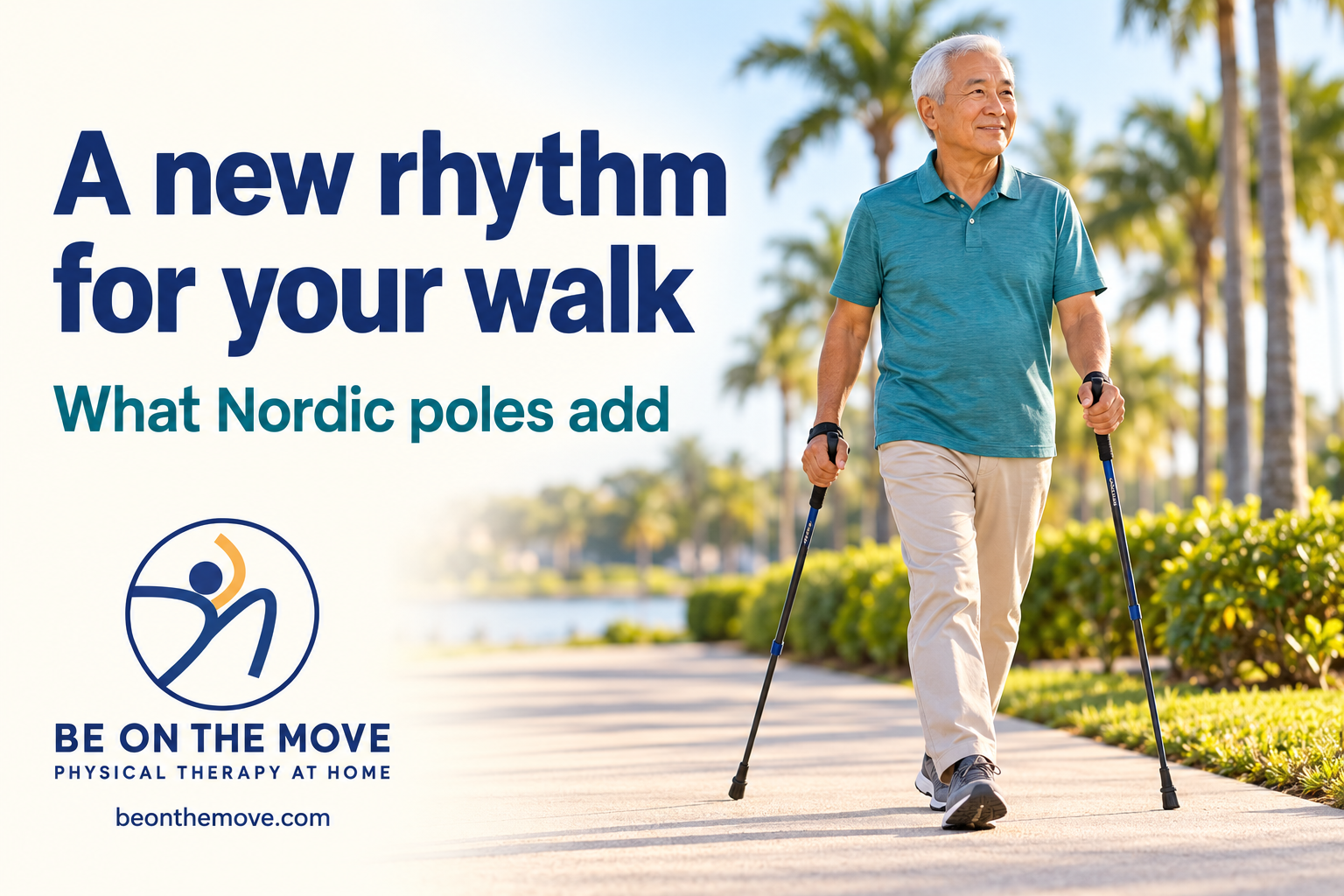
As Cleveland Clinic explains, Nordic walking uses a purposeful push through the poles, involving the arms and upper body as you walk. In a common technique, the opposite arm and leg move together and the poles angle backward. Carrying two poles without using that movement is a different experience.
Think of the extra equipment as adding a coordination task. Hands, arms and feet have to share a rhythm. This is why a demonstration and practice can matter more than buying the most expensive set. The useful question is whether the equipment helps you carry out the intended activity comfortably, not whether it makes your walk look more athletic.
The same clinic cautions that upper-body injuries may make pole use unsuitable. A sore wrist, recovering shoulder or painful elbow is relevant because those areas now have a job to do. Adding poles should not mean ignoring symptoms in order to keep up with a group.
A new study offers encouragement—with boundaries
A randomized study published in May 2026 assigned 32 adults aged 65–80 to Nordic or traditional walking; 28 completed the program. Participants trained under individual physiotherapist supervision three times weekly for 12 weeks. The Nordic group improved more on several measures, including chair stands, arm curls and six-minute walking distance. A timed mobility test did not show a clear difference between groups.
This was a small, supervised study with selected participants, baseline differences and an unblinded assessor. The groups also used different exercise-intensity targets, so the comparison does not isolate the poles alone. These findings support further interest in a structured program; they do not guarantee the same result from an unsupervised purchase.
The study assessed confidence about avoiding falls, rather than demonstrating fewer actual falls. Feeling more confident and experiencing fewer falls are different outcomes. Both matter, but one cannot be silently substituted for the other.
Ordinary walking was not the losing option
An earlier randomized trial published in PLOS ONE studied 33 previously untrained older adults over eight weeks. Both Nordic walking and walking without poles improved several measures. The researchers did not find the predicted Nordic-walking advantage for their main outcome, preferred walking speed, or most secondary outcomes.
Different studies can produce different answers because participants, training and measurements differ. That is more useful than treating every exercise as a contest with one permanent winner. The earlier trial does not prove poles never help; the newer trial does not prove that everyone needs them.
If your regular walk is an activity you enjoy and can do consistently, you have no obligation to replace it. Curiosity is a good reason to explore another format. Feeling that your current movement has become worthless because a new product appeared online is not.
Choose equipment for the job
Harvard Health describes Nordic poles with a glove-like strap system that helps transmit force through the hand. It also distinguishes surface tips: rubber for sidewalks, pointed tips for suitable trail surfaces. Fit matters, and a level surface is a sensible place to begin learning.
Ask a knowledgeable instructor to demonstrate the grip, release, adjustment and tips on the actual poles you would use. Try the fastening system yourself. A feature that looks convenient in a product photograph may be awkward for your hands. Check that you understand how to secure adjustable sections and how to inspect them before a walk.
Exercise poles and prescribed walking aids serve different purposes. If you rely on a cane or walker, do not replace it because Nordic poles look more sporty. Ask your physical therapist which equipment fits your balance, weight-bearing needs and walking pattern. The appropriate choice may be to keep your usual aid. There is no style award for using less support than you need.
Make the first outing a lesson
A first experience is easier to evaluate when you are learning one thing at a time. Choose instruction that lets you understand the pole movement before worrying about speed or distance. A good practical question is, “Can I stop, turn and restart without feeling tangled in the equipment?” That question is about learning the task, not passing a fitness test.
For Palm Beach County walkers, consider the actual space available on the path. Poles occupy room beside you; a broad, uncluttered route gives you more room to practice than a crowded narrow walkway. Plan where to pause, and keep the outing easy to shorten. Choosing a convenient learning space is more useful than making the first attempt into an ambitious excursion.
There is no universal starting distance in this article. Your normal walking ability and any medical restrictions should shape the first session. Recent surgery, recurring unsteadiness or new pain calls for individual guidance before adding a new exercise tool. An instructional video cannot see how your hands, shoulders and balance respond.
Judge effort by your body, not the equipment
The CDC's talk test gives a general way to think about aerobic effort: during moderate activity, you can talk but would have difficulty singing. At vigorous effort, saying more than a few words requires a pause for breath. The same activity can feel different to people with different fitness levels.
Owning poles does not tell you which intensity you are reaching. Nor does a photograph show how hard someone is working. If your clinician has given you a specific exertion limit, follow that guidance rather than matching a video's pace. Learning a comfortable rhythm can be the entire purpose of an early practice session.
CDC guidance for older adults includes aerobic activity, muscle-strengthening activity and balance work. Nordic walking can be one choice within that broader mix. It should not become a reason to drop exercises prescribed for a separate need. You can enjoy the variety of poles on some walks and leave them at home on others.
Look beyond the impressive clip
Before saving a video as your lesson, look for the part that is usually less glamorous: a clear explanation of what the person is doing with each pole. Can you see the hands and the tips, or does the camera show only a smiling face? Does the presenter distinguish a demonstration from an individualized recommendation? Are product claims supported by a study you can actually read?
You do not need to become a research specialist. Simply separating the demonstration, the sales pitch and the evidence makes the decision clearer. Save questions you cannot answer from the clip and bring them to an instructor or your physical therapist. A useful explanation should leave you understanding the activity better, rather than feeling pressured to buy immediately.
What to take from the research
- Learn the purpose: Nordic walking involves an active pole movement, not simply carrying sticks.
- Read the outcome: a confidence questionnaire does not count actual falls.
- Keep the comparison fair: a supervised program is different from buying equipment and heading out alone.
- Respect support needs: fitness poles do not automatically replace a prescribed cane or walker.
- Keep ordinary walking in the picture: poles are an option, not an entrance requirement for worthwhile movement.
If you are curious, begin with a demonstration and an honest discussion of what you want the poles to add. Be On The Move provides physical therapy at home in Palm Beach County. When pain, balance or recovery affects your walking, an assessment can help clarify your needs before you change equipment. Explore Be On The Move to learn about at-home physical therapy.
A new walking rhythm can be enjoyable without becoming a claim that one activity solves everything. The useful choice is the one you understand, can use appropriately and want to return to.
See you soon,
//❤️ Trudy//
The information provided in this article is intended for general educational and informational purposes only. It is not a substitute for professional medical advice, diagnosis, or treatment. Always seek the advice of your physician or other qualified health provider with any questions you may have regarding a medical condition or before starting any new exercise program. If you experience any pain or difficulty with exercises or advice mentioned in this article, stop immediately and consult your healthcare provider. Be On The Move and its representatives do not assume any responsibility for any aspect of healthcare administered with the aid of information provided herein.