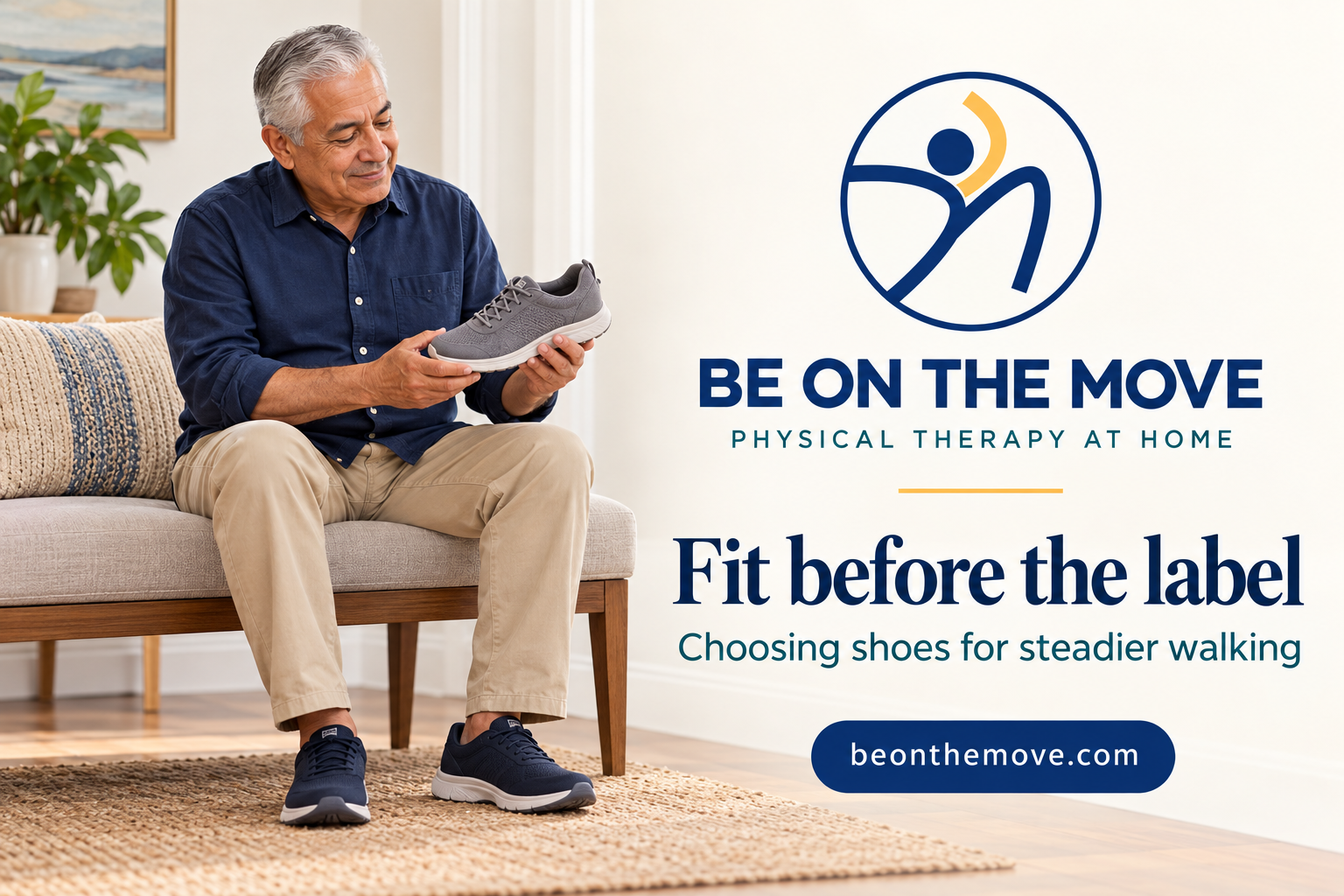
Choosing Shoes for Steadier Walking: Fit Before the Label
The shoes you wear most may be the pair you think about least. They are beside the bed, near the door or waiting under a favorite chair. You know how to get them on, so they become the automatic choice—even if the heel now slips or the fastening no longer holds as well as it once did.
Choosing a replacement can be surprisingly confusing. One advertisement praises cushioning; another says less cushioning is better. “Barefoot,” “zero-drop” and “supportive” appear to promise different answers to the same concern: feeling comfortable and steady while walking. A more useful starting point is the actual shoe on your actual foot, including how you fasten it and where you wear it.
This is a guide to sorting those details, not a list of brands to buy. A shoe label cannot diagnose the reason someone feels unsteady, and a comfortable fit does not make falls impossible. But understanding the parts of a shoe can make the choice less mysterious.
Why footwear is getting attention
Recent U.S. coverage includes Real Simple’s October 20 article about zero-drop shoes and an older woman’s experience and SFGATE’s October 15 discussion of transitioning to barefoot-style footwear. These shopping stories show current interest; personal experiences and product recommendations do not establish which shoe prevents falls.
Independent online discussions raise more practical questions: can footwear help a parent who is falling, and what happens when wide feet and difficulty tying laces complicate the choice? Those threads contain differing opinions, not verified treatment advice. Together with current coverage, they justify examining the topic carefully. They do not tell us how many seniors nationally use a particular shoe style.
Read the shoe from the ground upward
Heel-to-toe drop describes the difference in height beneath the heel and forefoot. Zero-drop means that difference is zero. It does not, by itself, tell you how thick the sole is, how soft the material feels or whether the shoe fits. Two shoes can share a drop measurement while differing in almost everything else.
The outsole is the part that meets the ground. The toe box is the front space around the toes. The heel counter is the structure around the back of the heel. The fastening holds the shoe on the foot. Looking at those features separately makes a broad claim such as “good support” easier to question: support where, and in what way?
A wide-looking front is not a substitute for checking length and depth. A thick sole is not a complete description of stability. An easy opening does not tell you whether the shoe remains secure after it is on. These are reasons to inspect the whole design rather than choosing from one photograph or one prominent label.
Start with today’s feet, not an old size
The American Geriatrics Society’s Health in Aging guidance notes that feet can flatten and widen with age. It recommends regular measurement, room for the toes, fitting the larger foot and shopping later in the day when feet may be more swollen. Its footwear advice also considers the heel structure, sole and traction.
That changes the meaning of “I have always worn this size.” The familiar number is a starting point, not a promise that every new pair will fit. A favorite style may also have changed between versions. Keeping the old box can help identify what you wore; it cannot confirm how the next model feels or fits now.
For a fitting visit, bring the socks you expect to wear and any prescribed inserts you normally use. Explain whether the concern is pressure across the toes, rubbing at the heel or difficulty getting the shoe on. “Uncomfortable” is a useful beginning, but locating the problem helps separate length, width, depth and fastening issues.
Imagine two different complaints: toes pressing against the front, and a heel rising out of the back. Calling both shoes “too small” would hide the difference. This example is not a diagnosis or a sizing formula; it illustrates why a description of where the shoe moves or presses is more informative than the number printed inside it.
Try the fastening as carefully as the fit
A shoe must be manageable during an ordinary morning, not just during a store demonstration. Consider how it opens, how you reach the fastening and whether you can secure it consistently. If a lace is difficult to tie, leaving the entire shoe loose changes how it is worn. An alternative fastening may be worth considering, but it still needs to hold the shoe appropriately.
The American Academy of Orthopaedic Surgeons discusses laces, buckles and straps, as well as room for inserts when needed. A removable insole can matter when an orthotic is part of the prescription. Do not discard a prescribed insert simply to make a new shoe feel roomier; have the shoe-and-insert combination checked.
Seated fitting is useful for getting shoes on, but the assessment should not end with their appearance in your lap. When it is safe for you to stand and walk, use your usual assistance and walking aid. A fitting should not become an unsupported balance challenge. Tell the fitter if you need a chair, extra time or another person nearby.
There is also a practical distinction between “easy to put on” and “easy to keep on.” Both deserve attention. A convenient opening can solve one problem while a loose heel creates another. It is reasonable to keep looking when a pair meets only half of your needs.
Give the first fitting enough attention
AAOS’s shoe-fitting guidance emphasizes matching the shape of the shoe to the foot and choosing footwear for the activity. It advises measuring feet, allowing room at the front and checking comfort rather than relying only on size. A pointed front and a rounded front can feel very different even when the labels match.
Before buying online, find out what a return actually requires. Can you try the shoes indoors? Must all packaging remain intact? This is a purchasing detail, not a medical rule, but it gives you a way to respond if the fit disappoints. A discount is less useful when the return window closes before you have checked the pair properly.
Keep the comparison simple. If one shoe presses over a toe and another slips at the heel, note those observations separately. You do not need a spreadsheet or a comfort score. A clear sentence about each problem is enough to prevent the next shopping attempt from becoming another guess.
What minimalist-shoe research actually found
A 2020 laboratory study compared conventional shoes, minimal shoes and barefoot conditions in 30 people with a history of falls. Some measured stability and mobility results favored minimal shoes. Short laboratory tasks, however, did not establish that participants would have fewer falls over time.
A later randomized trial published online in December 2025 and in a 2026 journal issue followed 65 older adults with fall risk. The minimal-footwear group improved on a balance test, but the study did not find a statistically significant difference in fall incidence at one year. It was too small to reliably settle that outcome. The full paper also shows that people lacking protective foot sensation and those with vestibular disorders were excluded. Some footwear was donated by a manufacturer.
That is useful evidence, with clear boundaries. It supports further consideration of footwear, not a promise that changing to minimal shoes will stop falls or suit every person with numbness or dizziness. There is no reason to throw away an appropriate prescribed shoe because a product category is receiving attention.
The indoor pair belongs in the conversation
Outdoor shoes may get a careful fitting while the indoor pair is chosen only for convenience. Yet walking from the bedroom to the bathroom is still walking. The distance being short does not tell you whether the shoe stays on or whether the floor is slippery.
The American Geriatrics Society’s home-safety guidance recommends well-fitting, nonslip footwear on smooth floors. Consider the pair you actually reach for at home when discussing footwear—not just the newer shoes you wear to appointments. Describe any loose fit, worn fastening or difficulty keeping the heel in place.
A useful comparison is between the shoe you intended to wear and the one you repeatedly choose because it is nearby. If they are different, convenience is part of the problem to solve. Keeping an appropriate pair accessible can matter more than purchasing another pair that remains in its box.
Numb feet need a different level of care
Reduced sensation changes the meaning of “it does not hurt.” The National Institute of Diabetes and Digestive and Kidney Diseases explains that diabetic nerve damage can make injuries harder to notice. Its guidance includes daily foot checks, checking inside shoes and wearing protective shoes and socks even indoors. Some people need special footwear or inserts.
If you have numbness, diabetes-related foot problems, an ulcer history or prescribed footwear, get individual advice before changing to a markedly different shoe. Do not use an absence of pain as your only fit test. Contact your healthcare provider promptly about a wound that is not healing or skin that becomes red, warm or painful. A shopping recommendation is not a substitute for assessing a foot problem.
Keep these details, whatever the brand
- Fit the feet you have now. An old size or favorite model may no longer tell the whole story.
- Separate the features. Drop, cushioning, toe space and fastening describe different things.
- Include everyday use. Getting the shoe on and keeping it secure both matter.
- Remember the indoor pair. Bring its problems into the conversation too.
- Treat reduced sensation seriously. Protection and individual foot care take priority over a footwear trend.
Be On The Move provides physical therapy at home in Palm Beach County. If walking feels unsteady, contact Be On The Move to discuss whether an in-home movement assessment fits your needs. Physical therapy can consider walking and balance in your everyday setting, while a foot-care clinician addresses problems requiring specialized footwear or medical treatment.
See you soon,
//❤️ Trudy//
The information provided in this article is intended for general educational and informational purposes only. It is not a substitute for professional medical advice, diagnosis, or treatment. Always seek the advice of your physician or other qualified health provider with any questions you may have regarding a medical condition or before starting any new exercise program. If you experience any pain or difficulty with exercises or advice mentioned in this article, stop immediately and consult your healthcare provider. Be On The Move and its representatives do not assume any responsibility for any aspect of healthcare administered with the aid of information provided herein.