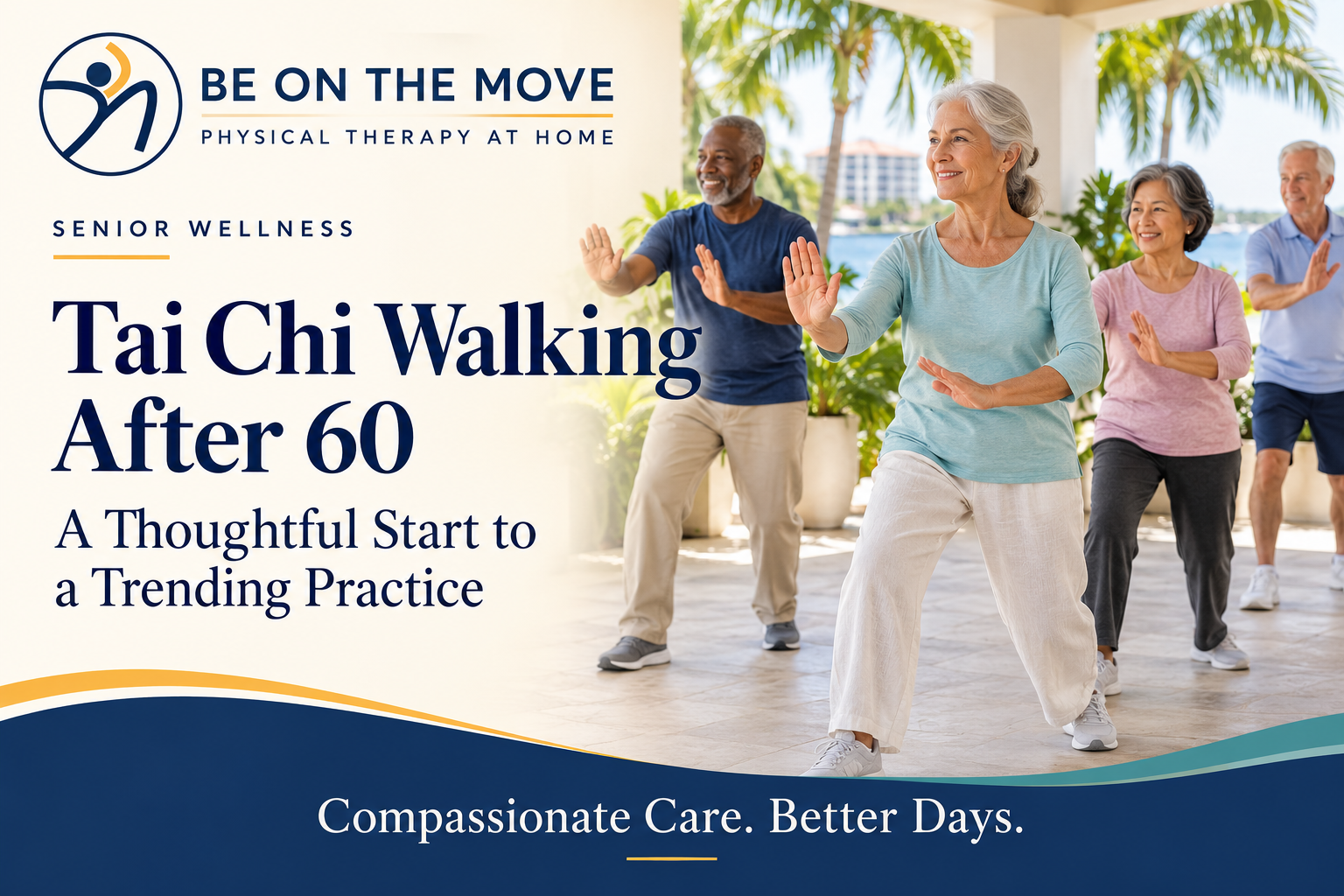
Why this walking trend deserves a closer look
A walking video can make a new routine look wonderfully simple. Someone moves slowly, shifts their weight, and takes another deliberate step. There is no race clock and no demand to keep up with a fast instructor. For an older adult wondering how to stay active, that invitation can feel much more welcoming than another fitness challenge.
Tai chi walking is receiving attention beyond a single creator. Harvard Health covered it in September 2026, following an August explanation in Vogue. Independent fitness channels have also published walking routines aimed at beginners and older adults. That makes it a timely subject to examine. It does not tell us how many American seniors practice it, and popularity alone cannot establish that a routine is right for you.
At Be On The Move, the useful question is practical: what would make this idea appropriate for your body, your surroundings, and the activities you want to enjoy? This guide separates the appeal of the trend from the decisions that deserve individual attention.
What tai chi walking actually means
Harvard Health describes tai chi walking as the footwork component of tai chi, practiced without learning an entire sequence of movements. Deliberate stepping and gradual weight transfer are central to the approach. Slowing down can challenge balance because you spend longer transferring support from one leg to the other.
That distinction matters when choosing a video. A routine called tai chi walking might include traditional instruction, a simplified walking practice, or a general fitness workout with similar branding. Read the description before following along. Look for an instructor who explains the purpose of each movement, offers appropriate modifications, and makes clear whom the session is designed for.
You do not need to imitate the depth of another person's stance or match an instructor's stride. An impressive-looking demonstration is not an assessment of your own movement. Treat the label as the beginning of a conversation about the activity, not a guarantee about its difficulty.
What the research supports—and what it does not
A randomized clinical trial published in JAMA Internal Medicine studied 670 adults aged 70 and older who had a high risk of falling. Participants attended structured exercise sessions for 24 weeks. The therapeutic Tai Ji Quan program involved two 60-minute classes each week and produced a lower fall rate than the comparison stretching and multimodal exercise programs.
Those findings concern a specific, carefully organized intervention. They do not prove that a short viral walking video produces the same result. Instructor training, exercise selection, supervision, practice time, and participant characteristics all affect how well research applies to an activity at home.
A sensible goal is to explore an enjoyable movement practice with realistic expectations. Be cautious about promises of dramatic weight loss, rapid muscle growth, or guaranteed fall prevention. Harvard Health explicitly challenges exaggerated online claims about weight loss and muscle building. A ten-minute video cannot establish what changed in someone's health, even if its before-and-after story sounds convincing.
Start with the question: is this appropriate for me?
If you have fallen recently, feel unsteady, experience dizziness, or need another person's help to stand, seek individual guidance before trying a standing balance routine. Johns Hopkins Medicine recommends talking with a doctor or physical therapist before new balance exercises, especially when balance is weak. Its own examples have limits on who should attempt them.
Bring specific observations to that conversation. Is turning harder than walking straight ahead? Do you hesitate at doorways? Does knee pain change the way you step? Do you feel different after standing up? These details can help you explain the problem much more clearly than saying you simply want better balance.
If you use a cane or walker, keep using it as prescribed. Ask how an activity can be adapted around that support. Do not put it aside to resemble a video. A person recovering from surgery, managing a neurologic condition, or following movement restrictions needs advice that accounts for those circumstances.
Prepare the space before practicing a movement
Think about where instruction will happen before deciding how long to exercise. Choose a clear, well-lit area with a level, dry surface. Move loose objects out of the route and avoid a space where pets, cords, or furniture require unexpected changes of direction. Put the screen where you can see it without repeatedly twisting or looking down.
For Palm Beach County residents, a comfortable indoor space may be easier to manage than an outdoor setting with glare, uneven pavers, or changing weather. An attractive patio is not automatically the best practice area. The best location is one where the setup supports your needs and where you can stop comfortably.
Ask your therapist or instructor what stable support belongs in your setup and whether someone should be present. A rolling chair is not a substitute for a secure support surface. Having a family member nearby may be useful, but it does not replace an assessment or training in how to assist you.
Make the first session a learning session
For someone who has been advised that this activity is suitable, the first session can focus on understanding instruction rather than finishing a full routine. Preview the video while seated. Notice whether it includes turns, backward travel, unsupported single-leg positions, or other movements you have not discussed with your clinician.
Ask an instructor to show a comfortable starting position and explain how to transfer weight without forcing a deep bend or a long step. Keep breathing naturally. There is no benefit to proving that you can copy the most challenging version on the screen. If the instruction is unclear, pause and ask for clarification rather than inventing a movement.
A useful first-session question is, "Could I follow the directions while feeling steady and comfortable?" Another is, "Did I know how to stop and return to a supported position?" These questions are more informative than counting how many minutes you completed. Stop if you develop pain, dizziness, or unusual symptoms and seek appropriate medical guidance.
Choose a teacher, not just an appealing thumbnail
A good video should make its purpose understandable before the exercise starts. You should be able to identify the instructor, the intended audience, and the kinds of movements included. Look for explanations of adaptations and a clear invitation to work within individual limitations. Be wary of an instructor who treats discomfort or instability as something everyone should push through.
Online popularity can help you discover an activity, but view counts do not tell you whether instruction fits your circumstances. A video aimed at adults over 60 still reaches people with very different abilities. A person who hikes regularly and a person rebuilding confidence after a hospital stay may need quite different starting points.
If you attend a class, describe your limitations privately before it begins. Ask whether the instructor has experience accommodating them and whether a seated or supported alternative is available. You should not feel pressured to participate in every movement simply because others are doing it.
Keep a well-rounded movement plan
For adults 65 and older, CDC guidance includes aerobic activity, muscle strengthening, and balance work. Its general weekly target is at least 150 minutes of moderate aerobic activity, or an equivalent amount of vigorous activity, plus strengthening on at least two days and activities that improve balance. People should be active according to their abilities and conditions when they cannot meet those targets.
A gentle tai chi walking session may fit into the balance portion of a plan. It should not automatically be counted as a replacement for all cardiovascular activity or strengthening. How demanding a session is depends on what you actually do and how your body responds.
Think of your week as a collection of purposeful activities rather than a contest between exercise trends. Your therapist can help you decide what belongs in that collection. An enjoyable routine can be valuable without having to promise every possible benefit.
Notice progress that matters in daily life
Instead of relying on a dramatic transformation claim, write down what you hope to do more comfortably. Perhaps you want to feel less rushed while moving around the kitchen or understand why a particular turn feels awkward. These are conversation starters, not promises that tai chi walking will resolve the problem.
Keep brief notes about instruction, comfort, and any difficulties. Bring recurring issues to your therapist rather than repeatedly practicing through them. If your needs change, the activity can change too. Continuing a routine exactly as shown is less important than having a plan that remains appropriate.
For a family member, encouragement can be simple: help prepare the space, respect prescribed supports, and let the older adult describe how the movement feels. Avoid turning the session into a test or insisting on a longer workout. A calm learning environment leaves room for questions and honest feedback.
A thoughtful next step with Be On The Move
You do not have to decide from a social-media clip whether tai chi walking belongs in your life. If you live in Palm Beach County and want help understanding your walking, balance, or movement concerns, contact Be On The Move to ask about physical therapy at home and whether our services fit your needs.
Tell us what you would like to do more confidently and what currently gets in the way. An individualized conversation can help connect the interest sparked by a trend with a practical next step. The aim is useful movement in your everyday surroundings, with appropriate support and realistic expectations.
Tai chi walking may be worth exploring. The strongest starting point is curiosity paired with good instruction—not pressure to keep up with the internet.
Sources and further reading
- Harvard Health: Tai chi walking, September 14, 2026
- Vogue: What Is Tai Chi Walking?, August 5, 2026
- JAMA Internal Medicine: therapeutic Tai Ji Quan randomized trial
- CDC: Older Adult Activity
- Johns Hopkins Medicine: Fall Prevention Exercises
See you soon,
//❤️ Trudy//
The information provided in this article is intended for general educational and informational purposes only. It is not a substitute for professional medical advice, diagnosis, or treatment. Always seek the advice of your physician or other qualified health provider with any questions you may have regarding a medical condition or before starting any new exercise program. If you experience any pain or difficulty with exercises or advice mentioned in this article, stop immediately and consult your healthcare provider. Be On The Move and its representatives do not assume any responsibility for any aspect of healthcare administered with the aid of information provided herein.